


You've hosted enough game nights to know the pattern. Someone suggests Catan. Half the room groans. Someone else pulls out Cards Against Humanity — again. By 9 p.m. the group has split into two conversations and nobody's actually playing anything.
So when a themed party set based on a Netflix show comes up as an option, the skepticism is fair. Is it a novelty item that loses its shine after twenty minutes? Or does the format actually solve the problem that most popular board games for adults quietly have?
That's the honest question this post is trying to answer.
What a standard adult board game actually delivers
Popular board games for adults — your Ticket to Rides, your Codenames, your Exploding Kittens — do a lot of things well. They're self-contained. The rules are printed inside the box. You can play them with almost anyone.
But most of them share a structural limitation: they're built around one mechanic. One game of Codenames is a word-association game from start to finish. One game of Ticket to Ride is a route-building game from start to finish. That's fine if everyone at the table loves that mechanic. The problem is that a group of eight adults rarely does.
Strategy players get bored in luck-heavy games. Casual players feel lost in games with twenty minutes of rules explanation. Competitive people check out when there's no real tension. You end up designing your game night around the least-common-denominator option, which is usually something that nobody finds particularly exciting.
There's also the social architecture problem. Most board games funnel the whole group into one shared activity — which sounds ideal, but in practice means that anyone who's losing or confused goes quiet and waits it out. The game is running; the party isn't necessarily.
What the Squid Game set is actually doing differently
The Bolaball Squid Game-Themed Party Game Set isn't a board game. It's a collection of distinct challenges pulled from the show — and that distinction matters more than it sounds.
The set includes the Dalgona candy challenge (carving shapes from a delicate honeycomb disc without breaking it), Ddakji (flipping paper tiles with a throw — a Korean game that's deceptively simple and instantly competitive), a Marbles game, tug-of-war with an actual rope, and replica invitation cards to set the scene. The dark wooden button console with its four colored hexagonal buttons — yellow triangle, blue square, red circle, green circle — acts as a centerpiece prop. There's also a wooden spinning top, stone-style game pieces engraved with shapes, and a golden tassel that reads as a trophy or a joke depending on who wins.
What this format creates is variety within a single evening. You're not playing one mechanic for two hours. You're cycling through skill challenges, luck moments, and head-to-head social pressure — the kind of mix that keeps different personality types engaged at different points in the night.
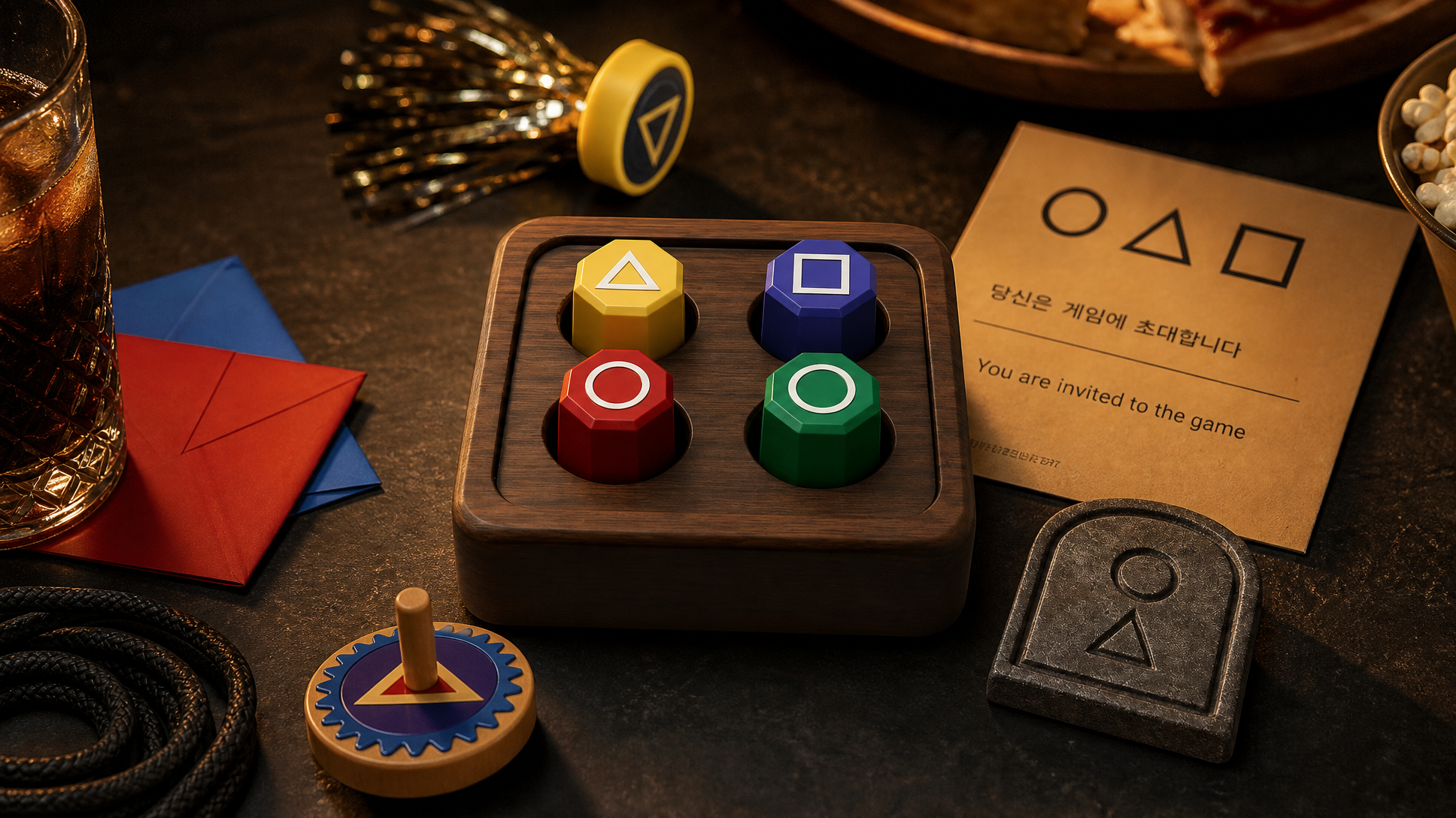
The Dalgona challenge, in particular, does something most party games can't: it creates individual suspense in a group setting. Everyone watches one person try not to crack their shape. The room goes quiet. That's a party moment, not just a game turn.
The honest trade-offs
A themed set like this isn't universally better. Here's where it falls short compared to a classic board game:
- Replayability. A well-designed board game can be pulled out a dozen times. The Squid Game set is tied to a cultural moment and a specific vibe — it works best when that vibe is the point of the evening.
- Crowd fit. If your group hasn't seen the show, some of the immersion is lost. The games still work on their own merits, but the invitation cards and the aesthetic hit differently when everyone gets the reference.
- Setup intention. A board game is low-commitment. This set rewards a host who leans into it — dim the lights, set out the props, maybe make it a themed night. That's more effort, but it's also what makes it memorable.
And where it wins:
- No single mechanic fatigue. The multi-challenge format means the night has natural momentum and reset points. If someone's terrible at Ddakji, they get another shot at something completely different.
- Built-in spectacle. The wooden console, the kraft paper invitations, the rope — these are props, and props make a party feel like an event rather than a Tuesday night.
- Genuinely broad appeal. Skill games, luck games, physical challenges — there's something in the mix for people who hate strategy games and people who hate random-draw games equally.
Who should actually buy this
If you're hosting a birthday, a Halloween party, or any adult gathering where you want people talking about it afterward — this is the format that creates those stories. The host who wants a reliable, repeatable game night staple is better served by a great board game. But if the goal is one night that feels different, the themed multi-challenge format has a structural edge over anything that fits in a single box with a single rulebook.
The question isn't really "themed set vs. board game." It's "what kind of night do you want to host?" If the answer involves a room full of people arguing over whether someone's Dalgona umbrella is cracked, you already know which way to go.
See everything included in the Bolaball Squid Game-Themed Party Game Set before you plan your next party — the full contents are worth a look before you decide.
Frequently Asked Questions
Do guests need to have watched Squid Game to enjoy the party set?
Not strictly — the individual challenges (flipping tiles, carving a shape, tug-of-war) work on their own as party games. But the full atmosphere and the "invitation to the game" moment lands a lot harder when everyone in the room knows the reference. It's worth a quick heads-up to guests beforehand if you want the theme to really land.
How many people can play at once?
The set is designed for group play, and several of the challenges (like Dalgona and tug-of-war) work especially well when the rest of the group is watching and reacting. The exact player count can flex depending on how you structure the evening — head-to-head rounds with spectators tends to keep energy high across a larger group.
Is this appropriate for all ages, or is it strictly an adult party game?
The set is aimed at fans of the Netflix series, which is adult content, so the theme skews toward adult and young adult gatherings. The individual games themselves — spinning tops, tile flipping, tug-of-war — are physically accessible to older kids, but the Squid Game framing and atmosphere is best suited to adult or teen-and-up parties.
Can this work for a team-building event, not just a party?
Yes, with a bit of structure. The mix of individual skill challenges and team-based games like tug-of-war makes it adaptable for small group settings where you want a mix of competition and collaboration. Modified rules — like scoring by team rather than individual — can shift the dynamic from cutthroat to cooperative pretty easily.