


The first time you sit a five-year-old down in front of a 4 in a Row board, they will almost certainly try to fill every single slot in one column before touching another. Not because they don't understand the game — they haven't been told the goal yet. That one moment is where most adults go wrong: they over-explain, demo three rounds, and accidentally make the game feel like homework before a single disc has dropped.
Here's a better way.
Start with the goal, not the rules
Before you touch a disc, say exactly this: "First one to get four of their color in a row wins — up, across, or diagonal." That's it. One sentence. Don't explain blocking yet. Don't explain diagonals in depth. Just point to an empty row on the board and trace a line with your finger. Kids this age learn by doing, and the rules will click the moment they see a line forming.
The giant format actually helps here. Oversized discs are easy for small hands to grip and satisfying to drop — the physical act of placing a piece is engaging enough that a five-year-old stays focused while they figure out the logic underneath.
Let them go first, every time (at least to start)
Going first in 4 in a Row is a small but real advantage, and giving it to a new player isn't just being nice — it lets them set the tempo. They'll pick a column, drop their disc, and watch what you do next. That cause-and-effect loop is how young kids start to build spatial reasoning around the game.
For the first round or two, don't play to win. Play to react visibly. When they drop a disc, look at the board, pause, and say "hmm, I need to watch that column." You're not giving away strategy — you're showing them that their moves matter. That's the thing that hooks a kid: the moment they realize you're actually paying attention to what they're doing.
Introduce blocking naturally, not as a lesson
Somewhere in the second or third game, they'll get three in a row. Let it happen. Then block them — obviously, directly — and say "I had to stop you there, you were one away." Don't explain the rule. Just do it. They'll immediately start scanning for your three-in-a-rows, because now they know what almost-winning looks like.
This is the moment the game shifts from color-matching to actual strategy, and it happens on its own if you don't rush it. You didn't teach blocking. They figured out blocking because you showed them it was possible.
The "let them win" question — answered honestly
Don't throw games. Kids know when you're doing it, and it makes winning feel hollow. What you should do is play at maybe 60–70% of your normal attention — make real moves, but don't spend three turns setting up a diagonal trap they have no chance of seeing yet. Play the game genuinely, just without the full-court press.
When they do win a round legitimately, they'll feel it. That's the win worth having. And when you win, don't minimize it — "good game, want to go again?" is all you need. Treating their loss like it's no big deal is actually more respectful than softening the result.
Playing with a mixed-age group
This is where giant 4 in a Row earns its place at a family gathering. When you've got a five-year-old, a ten-year-old, and two adults all waiting to play, you don't need separate games for different skill levels. The younger kid pairs with an older player or adult as a loose team, talking through moves together. The older players can play each other straight.
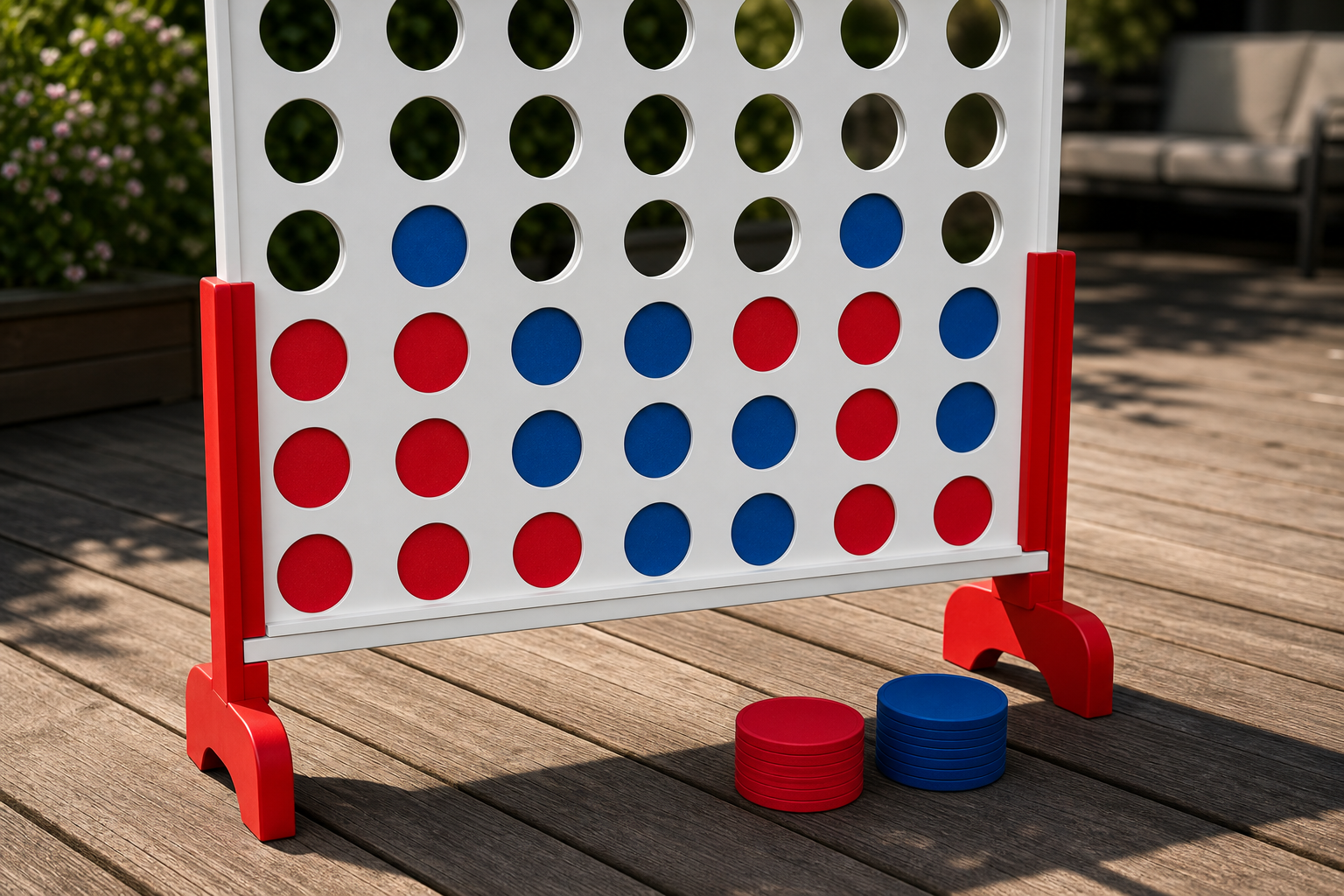
The oversized board means everyone around the table can see the game state clearly — no squinting at a small plastic grid. That visibility is what makes it a spectator sport as much as a two-player game. People watch, people comment, someone spots a diagonal the active player missed. It becomes a group experience without anyone having to orchestrate it.
A few moves worth showing a beginner
Once your five-year-old has played a handful of rounds and is genuinely trying to win, you can introduce one idea per session — not as a rule, just as something to notice:
- The middle column is valuable. Pieces in the center connect to more potential rows than pieces on the edges. You don't need to explain why — just say "I like playing in the middle" and let them watch it play out.
- Two threats at once. If you set up two ways to get four in a row at the same time, your opponent can only block one. Show it happening in a real game, not as a demo.
- Bottom rows fill up fast. Dropping pieces low early gives you more options later. Again, just something to observe, not a rule to memorize.
These aren't tips you deliver in a pre-game speech. They're things you mention once, casually, when the moment in the game makes them obvious. A five-year-old won't retain a strategy lecture — but they'll remember something they saw work.
When they want a rematch at 9 p.m.
That's the sign it worked. Giant 4 in a Row has a natural "one more game" pull because rounds are short enough that losing doesn't sting for long, and winning feels earned. The collapsible design means you can pack it up quickly when bedtime actually wins — no loose pieces scattered across the yard, no complicated breakdown.
The Bolaball Giant 4 in a Row features a durable wooden frame, 42 oversized discs in red and blue, and a travel bag with separate pockets for the coins and legs — so it moves easily from the backyard to a BBQ to the living room floor without becoming a storage headache. No tools needed to set it up or take it down, which matters when you've got a five-year-old who wants to start immediately.
Teach the game right once, and you won't have to teach it again. They'll be explaining the rules to someone else by next weekend.
See the Bolaball Giant 4 in a Row — solid wood, red and blue discs, includes a carrying bag. Find it at bolaball.com.
Frequently Asked Questions
What age is 4 in a Row actually appropriate for?
Most kids can grasp the basic goal of 4 in a Row — get four of your color in a line — around age 4 or 5. At that age they're playing more intuitively than strategically, which is perfectly fine. The game grows with them: by 6 or 7, most kids start blocking naturally, and by 8 or 9 they're thinking a move or two ahead. The giant format with oversized discs makes it especially accessible for younger kids who'd struggle with a smaller tabletop version.
Should I explain diagonals to a young child before we start playing?
Skip it at first. Diagonals are the hardest pattern for young kids to spot, and front-loading that explanation usually just creates confusion before the game even starts. Let them play a round or two without mentioning it. When a diagonal win actually happens — yours or theirs — point to it then. Seeing it in context is far more effective than a pre-game explanation.
How do you keep older kids or adults engaged when playing with a much younger child?
Pair the younger child with an older player as a loose team, where they discuss moves together rather than playing solo. The older player gets to think strategically while guiding the younger one, and the younger child still feels like an active participant. Alternatively, run a mini-tournament format where multiple people rotate in — the spectator element of a giant board keeps everyone involved even when they're not actively playing.
Is the giant version harder to store than a regular 4 in a Row game?
It's larger than a tabletop version, but the Bolaball Giant 4 in a Row is designed with portability in mind. The frame is collapsible and requires no tools to assemble or disassemble, and it comes with a dedicated carrying bag that has separate pockets for the discs and the legs. Most families store it in a garage, shed, or large closet without any trouble, and it travels easily to outdoor events.