


Most parents have learned to be suspicious of the word 'educational' on a toy box. It usually means a flashcard in disguise, or something that holds a child's attention for eleven minutes before ending up under the couch. What nobody puts on the box — because it doesn't sell as well — is that some of the oldest, simplest outdoor games quietly build the same skills those overpriced 'brain development' toys promise, and they do it while kids are too busy competing to notice.
This isn't a post about learning outcomes or developmental milestones. It's about what's actually happening in a child's head during a game of giant 4-in-a-row, washer toss, or tumbling blocks — and why those things matter more than the game's age rating suggests.
1. Giant 4-in-a-Row: Spatial Reasoning in Real Time
Spatial reasoning — the ability to mentally rotate shapes, visualize patterns, and predict how a space will fill — is one of the strongest predictors of success in math and science, according to researchers at the NIH and others who study cognitive development. It's also exactly what a child is doing every single turn in a game of giant 4-in-a-row.
Watch a six-year-old play. They're not just dropping a disc. They're scanning a grid, tracking their own pieces, tracking their opponent's, identifying threats, and mentally simulating what the board will look like two moves from now. That's a lot of cognitive work dressed up as a game.
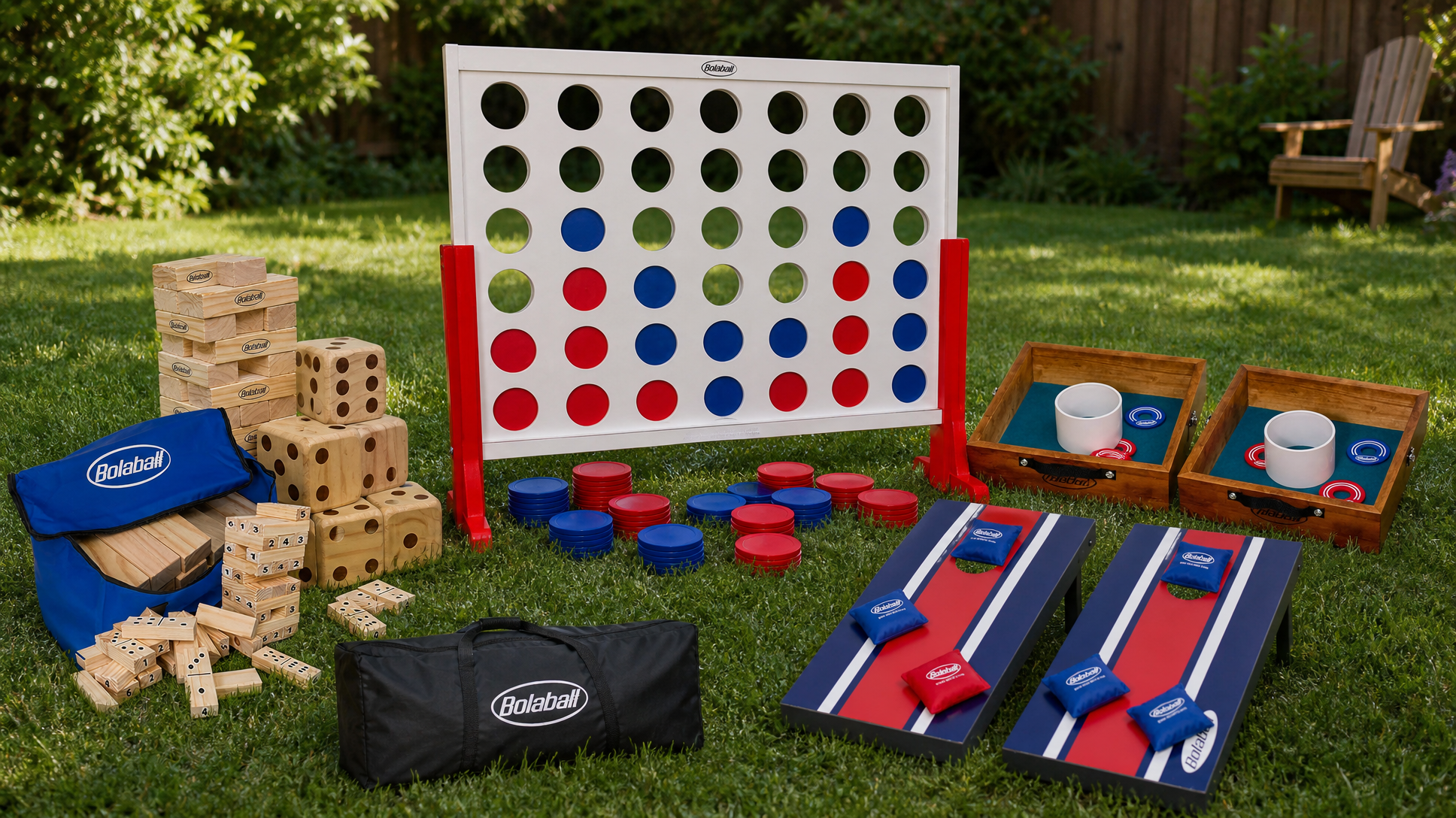
The Bolaball Giant 4-in-a-Row makes this particularly effective because of its scale. The board is large enough that the whole grid is visible at a glance — no squinting, no losing track of a row. The oversized red and blue discs are easy for small hands to manage, and the visual contrast between colors makes pattern recognition faster and more intuitive. When a child spots a diagonal threat forming three columns away, that's not luck. That's spatial pattern recognition, practiced in real time.
It also introduces kids to something harder to name: strategic empathy. You can't block a move you haven't imagined your opponent making. Anticipating someone else's plan is a genuinely sophisticated mental skill, and it shows up naturally in this game because the stakes feel real — even if the stakes are just bragging rights at a backyard BBQ.
2. Washer Toss: Distance Estimation and the Feedback Loop of Motor Control
Here's something washer toss does that almost no indoor toy can: it forces the body and brain to work together across real physical space, with real consequences for getting it wrong.
When a child picks up one of the Bolaball Washer Toss set's 2.5-inch steel-centered washers and lines up a toss, they're running a quick unconscious calculation — how far away is the target, how hard do I need to throw, what angle gets this into the cup versus just onto the felt? They throw. They miss. The next throw adjusts. That loop — estimate, execute, observe, recalibrate — is exactly how motor learning works, and it happens dozens of times in a single game.
The solid wood target boxes with their blue felt lining and central white cups give kids a clear, satisfying reference point. Landing in the cup versus landing on the board versus missing entirely provides immediate, unambiguous feedback. There's no parent needed to explain whether it worked. The washer either went in or it didn't. That clarity is what makes the learning stick.
Older kids start to develop genuine throwing technique — adjusting for wind, distance, and spin — without anyone calling it technique. They just call it getting better at the game.
3. Tumbling Blocks: Cause-and-Effect Thinking (With Consequences)
The Bolaball Giant Outdoor Game Set's 45 pine wood tumbling blocks are the most viscerally satisfying of the three, and also the one that teaches the most uncomfortable lesson: every decision has structural consequences, and sometimes you inherit someone else's bad ones.
A child pulling a block from the lower third of a wobbling tower is doing real-time structural analysis. Which blocks are load-bearing? Which can move freely? What happens to the blocks above if this one shifts? They're testing hypotheses with every pull, and the tower is giving them instant, honest feedback. When it falls — and it will fall — there's no ambiguity about why.
This kind of cause-and-effect reasoning is foundational to scientific thinking, engineering, and honestly just good judgment. And it's happening while everyone around the table is laughing and groaning and daring each other to pull the next block. The giant dice and 28 wooden dominoes in the same set add variation — different games, different rule structures, different kinds of thinking — so a single afternoon can cycle through strategy, probability, and sequencing without ever feeling like a lesson.
If you want to see what giant dice games actually look like in practice, that's worth a read before your next gathering.
4. Cornhole: Reading the Environment and Adjusting
Cornhole doesn't get enough credit as a thinking game. The Bolaball cornhole set — two 2x3 ft wooden boards with a scratch-resistant laminate surface, eight canvas beanbags with double-sewn seams, and foldable legs — looks like pure fun. It is pure fun. But underneath that, kids are constantly adapting.
Wind direction, sun glare, uneven ground, the weight of a slightly different bag — outdoor games demand environmental awareness that indoor games simply can't replicate. A child who plays cornhole regularly gets good at reading conditions and adjusting their approach. That's not a small skill. Adults spend careers trying to develop it.
The team format also introduces something genuinely valuable: shared accountability. When your partner misses, you don't quit — you cover. When you're behind, you problem-solve together. That dynamic is harder to manufacture in a classroom setting than it looks.
5. All of Them Together: The Case for Mixed-Game Afternoons
The real argument here isn't that any one of these games is secretly a curriculum. It's that an afternoon rotating through giant 4-in-a-row, washer toss, tumbling blocks, and cornhole gives kids a genuinely varied mental workout — spatial reasoning, motor calibration, structural thinking, environmental adaptation — without a single moment that feels like work.
The Bolaball Giant Game Set's combination of tumbling blocks, jumbo dice, and dominoes in one portable pine wood set makes that rotation easy. The Giant 4-in-a-Row and Washer Toss each pack down into their own carrying bags. The cornhole set folds flat. You can fit a full afternoon of varied play into the back of a car, set up in ten minutes, and be playing before anyone has time to reach for a screen.
That's the actual pitch. Not that these games are educational. Just that they're genuinely good — good enough that kids want to keep playing, which is the only condition under which any real learning happens anyway.
Check out the Bolaball Giant 4-in-a-Row, Washer Toss, Giant Game Set, and Cornhole Set at bolaball.com and see which ones belong at your next backyard gathering.
Frequently Asked Questions
What age is giant 4-in-a-row appropriate for?
The Bolaball Giant 4-in-a-Row is suitable for ages 3 and up, making it genuinely playable across a wide age range. Younger kids enjoy the physical act of dropping the large discs, while older kids and adults engage with the strategic side of the game. It's one of the few outdoor games where a seven-year-old and a grandparent are actually competing on similar footing.
Can these games be played indoors?
Most of them, yes. The Giant 4-in-a-Row and the tumbling blocks, dice, and dominoes from the Giant Game Set work well indoors on a hard floor or large table. Washer toss and cornhole are better suited to outdoor spaces with a bit of room, though cornhole can be played in a garage or large living area if you have the clearance.
How do you store and transport these games?
All four Bolaball games are designed with portability in mind. The Giant 4-in-a-Row comes with a canvas carrying bag with separate pockets for coins and legs. The Giant Game Set includes a durable blue carry bag for all its components. The Washer Toss boxes latch together with built-in handles — no separate bag needed. The cornhole set comes with a heavy-duty zippered carrying case. Setup for all of them is quick, with no tools required.
Are these games durable enough for regular outdoor use?
The Bolaball games are built from solid wood — pine for the Giant Game Set, solid wood frames for the 4-in-a-Row and Washer Toss — which holds up well to regular outdoor play. The cornhole boards have a scratch-resistant laminate surface, and the beanbags feature double-sewn seams for durability. As with any wood product, keeping them out of prolonged rain and storing them properly between uses will extend their life significantly.