


You've been there: someone hauls out a classic board game at a family BBQ, and within ten minutes there's a missing piece, a warped card, and a seven-year-old who's already wandered off to throw a frisbee. Box games are great for rainy Sunday afternoons. They're not built for a backyard, a park blanket, or a camping trip where the flattest surface is a cooler lid.
The good news is that the category of games has expanded well beyond cardboard. There's a whole world of outdoor-friendly family games that play like classics — strategic, social, easy to learn — but are built to actually survive the places families gather. The trick is knowing what to look for before you buy.
The Real Criteria for a Great Outdoor Family Game
Before you pick a specific game, it helps to run any option through four honest filters. Skip any one of these and you'll end up with something that collects dust after two uses.
1. Does it need a flat surface?
This is the first thing most buyers overlook. A game that requires a perfectly level table is automatically out at the beach, in the grass, or on a campsite. Look for games where the playing surface is self-contained — targets you stake into the ground, structures you build up from a flat base, or toss games where the field is just open space. The best outdoor family games create their own environment rather than depending on one.
2. What happens when it gets knocked around?
Paper cards, thin plastic tokens, and hollow game pieces don't survive a season of real outdoor play. Solid wood construction is worth paying attention to here — not because it sounds premium, but because it's genuinely more practical. Wooden blocks don't crack the same way hollow plastic does when dropped on concrete. Wooden targets don't warp the way cardboard does after a humid weekend. Durability isn't a luxury feature; it's what separates a game you'll still be playing three summers from now from one you toss after one.
3. Can a mixed-age group actually play together?
The family game dream — grandparents, parents, kids, and teenagers all genuinely competing — dies fast when the rules are too complex for younger players or too simple for older ones. The sweet spot is a game with a low skill floor and a real competitive ceiling. Tumbling block games, target toss games, and connect-style games all hit this mark well: a six-year-old can play on the same team as an adult without anyone feeling like they're babysitting the rules.
4. How long does setup and teardown actually take?
If a game takes fifteen minutes to set up and needs a dedicated storage bag with labeled compartments, it's going to stay in the car most of the time. The games that actually get played are the ones you can pull out, set up in under two minutes, and toss back in a bag when the food's ready. Portability isn't just about size — it's about the whole friction of getting a game going in a spontaneous moment.
Game Types That Hold Up Outside
Once you've got the criteria in mind, it's easier to match them to the right game format. Here's how the main categories stack up for outdoor family play.
Tumbling Block Games
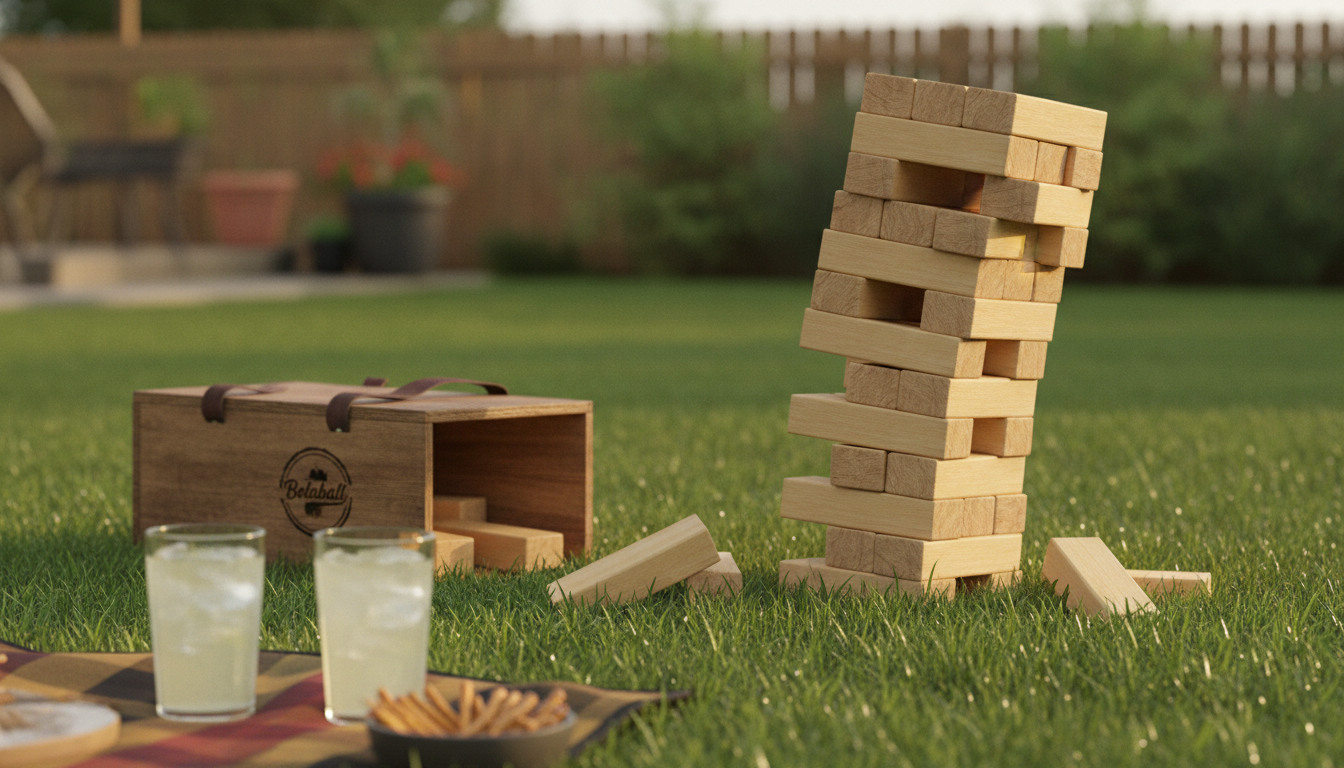
These are the outdoor version of a classic stacking game, scaled up to giant wooden blocks. Players take turns pulling blocks from a tower and stacking them on top — the tension builds fast, and the crash when it falls is genuinely satisfying for every age. At a larger scale, the game is easy to see from across a yard, which makes it naturally social even for people who aren't playing. A set like the Bolaball Giant Outdoor Game Set combines tumbling blocks with dominoes and dice in one kit, which means you're getting multiple game formats in a single purchase — useful when you want options depending on how many people show up.
Toss and Target Games
Washer toss and ladder toss are two of the most underrated formats for mixed-age family play. The rules take about sixty seconds to explain, the physical skill scales naturally with age (younger kids just stand closer), and both games allow for team play that keeps everyone involved. Solid wood targets hold up far better than hollow plastic ones — they don't blow over in a breeze and they don't crack when a washer hits the edge at a bad angle. The Bolaball Washer Toss Game Set and the Bolaball Pro Ladder Toss Game Set are both worth a look if this format fits your crew.
Giant Connect-Style Games
A scaled-up four-in-a-row game is one of the few formats where a ten-year-old and a grandparent are genuinely on equal footing — the strategy is real, but the rules are zero-learning-curve. The Bolaball 4 in a Row Game is built for both indoor and outdoor use, which matters if you want something that works on a patio table in summer and a living room floor in winter without buying two separate games.
Active Sport Games
For families who want something with more movement, pickleball has become one of the fastest-growing backyard sports for exactly the right reasons: it's easy to learn, the court is smaller than tennis, and it works for a wide age range. If you're adding a sport game to the rotation, a quality paddle set with the right gear to get started matters more than most people expect. The Bolaball Pickleball Paddles Set of 4 is worth considering if your family leans toward the more active end of outdoor play.
And if you already own a set of giant wooden dice, the variety of games you can run with them is bigger than most people realize — from outdoor versions of classic dice games to entirely new formats. This guide to outdoor dice games is a good starting point for getting more mileage out of a dice set you might already have.
What to Skip (Even If It Looks Good Online)
A few things that look promising in product photos but consistently disappoint in real outdoor use:
- Games with small, loose pieces. Grass swallows small tokens. Sand swallows everything. If losing one piece breaks the game, it's not built for outside.
- Hollow plastic construction marketed as 'outdoor-ready.' Hollow plastic warps in heat, cracks in cold, and fades fast in UV. Solid wood isn't the only good material, but it's a reliable benchmark.
- Games with more than one page of rules. At a backyard gathering, nobody's reading a rulebook. If you can't explain the game while you're setting it up, it won't get played.
- Sets with no carry bag or case. Loose pieces in a cardboard box don't survive a trunk. A carry bag isn't a bonus — it's a basic requirement for anything calling itself portable.
Buying for Different Situations
The right game also depends on where you're most likely to actually use it. A quick mental map:
Backyard BBQs and parties: Prioritize games that work as a spectator sport — tumbling blocks and toss games have a natural audience even when people aren't playing. The noise and drama of a tower falling keeps a whole yard engaged.
Parks and picnics: Go for the lightest, most self-contained format. Toss games with targets you can stake into the ground are ideal — no table required, packs flat, plays anywhere.
Camping trips: Durability and compact storage are non-negotiable. A solid wood set that packs into its own bag and doesn't need electricity, a flat surface, or a dozen small pieces is the right call.
Rainy days and indoor use: If you want one game that genuinely works both ways, connect-style games and tabletop versions of classic formats hold up indoors without feeling like a compromise.
One Last Thing Before You Buy
The best family game isn't the one with the most five-star reviews — it's the one that matches how your family actually gathers. If you're always at a park with no tables, a game that needs a flat surface is a bad buy no matter how good it looks. If your family skews toward younger kids, a game with a five-minute learning curve beats a strategic masterpiece every time.
Get those details right, and the specific game almost picks itself. Browse Bolaball's full lineup of outdoor and indoor games at bolaball.com — free shipping on every order, and the range covers most of the formats and situations covered in this guide.
Frequently Asked Questions
What age range do outdoor family games typically work for?
Most well-designed outdoor lawn games — tumbling blocks, toss games, giant connect-style games — work well from around age five or six up through adults of any age. The key is choosing a format where younger players can participate meaningfully without the game being dumbed down for older ones. Toss games are especially good here because players can simply adjust their distance based on ability.
Is solid wood actually better than plastic for outdoor games?
For most lawn game formats, yes — solid wood holds up better to repeated outdoor use than hollow plastic. It's more resistant to warping from humidity, less likely to crack on impact, and generally more durable over multiple seasons. It also tends to feel more substantial during play, which matters for games like tumbling blocks where the weight of the pieces is part of the experience.
Can outdoor lawn games be played indoors too?
Many can, especially scaled-up versions of classic games like connect-four or tumbling blocks — they work perfectly well on a living room floor or a large table. Toss and target games are trickier indoors depending on your space, but the game formats themselves translate well. If you want maximum flexibility, look specifically for sets labeled for both indoor and outdoor use.
How do I know if a game is actually portable enough for camping or a park?
Check whether it comes with a dedicated carry bag or case — that's the clearest signal the manufacturer designed it with transport in mind. Also look at whether it requires a flat or level surface to play, and count the number of loose pieces. Fewer pieces, a carry bag, and no table requirement are the three practical markers of a genuinely portable game.