


Every parent has stood in a toy aisle staring at a box that promises to teach "critical thinking" and "problem-solving" through some combination of plastic gears and a laminated instruction sheet. And every parent has also watched a kid abandon that toy within a week. Meanwhile, the same kid will spend two hours in the backyard arguing about whether a washer was inside the box or not, recalculating their score three times, and devising a new throwing strategy after every round.
That's not just fun. That's STEM — just without the branding.
This isn't a post that's going to tell you lawn games are secretly math class. They're not. But if you're the kind of parent who wants your kid building real mental muscle while they're also laughing and running around outside, it's worth understanding what's actually happening in their brain when they play.
The Problem With "Educational" Labels
The STEM toy market has exploded over the last decade. Walk into any big-box store and you'll find coding robots, engineering kits, and circuit-building sets all marketed at kids as young as four. Many of them are genuinely good. But the label creates a false boundary: this toy is educational, that toy is just fun.
Real skill development doesn't respect that line. Research in child development consistently shows that unstructured, active play is one of the most effective environments for building the kind of flexible thinking STEM fields actually demand — spatial reasoning, estimation, cause-and-effect logic, and iterative problem-solving. The difference between a coding toy and a lawn game isn't what's being learned. It's what the packaging says.
What Kids Are Actually Practicing Outside
Spatial Reasoning: More Than Just Aim
When a kid lines up a toss — whether it's a washer, a ladder ball bola, or a giant wooden block — they're doing something cognitively sophisticated. They're mentally mapping distance, height, and trajectory before their arm moves. They're adjusting that map in real time based on what happened last throw. This is spatial reasoning, and it's one of the strongest early predictors of success in math and science.
The key is repetition with feedback. A worksheet gives a child a problem and then an answer. A lawn game gives a child a problem, an immediate physical result, and another chance to try. That loop — attempt, observe, adjust — is exactly how spatial intuition gets built.
Estimation and Number Sense
Scorekeeping in yard games is underrated as a math activity. It's not rote arithmetic — it's applied number sense under mild social pressure, which is a completely different cognitive load than a textbook problem.
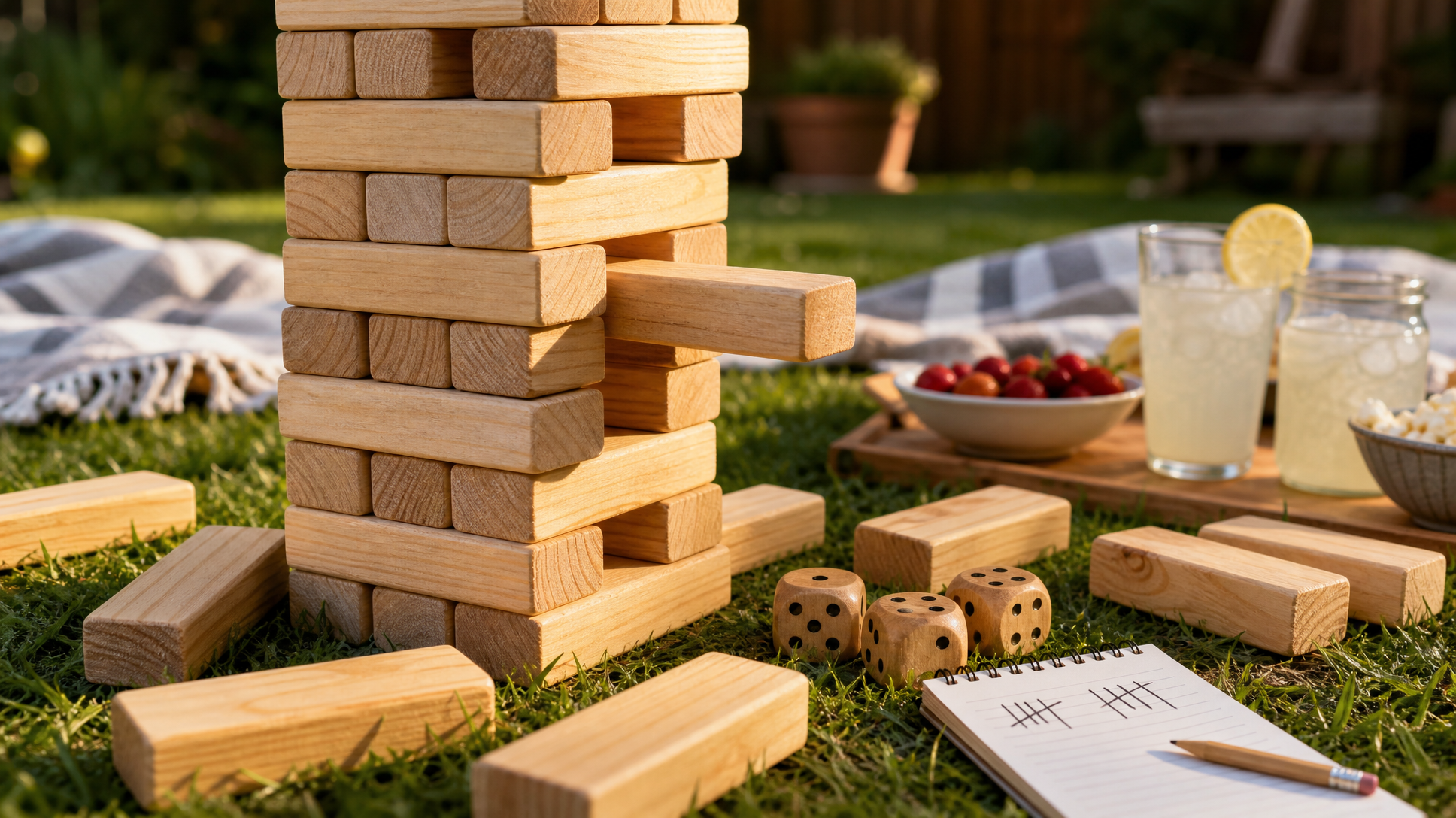
A kid tracking their score in a game of giant dominoes or a dice-based tumbling block game has to hold running totals in their head, compare their number to someone else's, and figure out what they need to catch up or stay ahead. That's mental math with stakes. It sticks in a way that worksheets rarely do.
Dominoes in particular are worth calling out. Matching pips, planning which tile to play, and thinking two or three moves ahead involves pattern recognition and strategic thinking that maps almost directly onto early algebra concepts — identifying relationships between quantities and anticipating outcomes.
Cause and Effect, Tested in Real Time
This one sounds obvious, but it's deeper than it appears. When a child throws a bola and it wraps around the wrong rung, or when they pull a block from a tumbling tower and the whole thing wobbles, they're running a live physics experiment. They're forming a hypothesis ("if I throw softer, it'll drop lower"), testing it, and revising their mental model based on what happens.
That iterative loop — hypothesis, test, observe, revise — is the scientific method. Not as a concept they're taught, but as something they're doing, naturally, because they want to win.
Social Math: Turns, Rules, and Fair Play
There's a category of thinking that doesn't get enough credit in STEM conversations: the logic of rules and fairness. When kids play a game with multiple players, they're constantly reasoning about whose turn it is, whether a rule was followed correctly, and how to resolve a disagreement. This is logical and procedural thinking — the same kind that underlies computer programming and legal reasoning.
It also happens to be where most of the real arguing occurs, which means it's also where a lot of the real learning happens. A kid who talks their way through a disputed score is practicing more structured reasoning than they realize.
The Games That Do This Best
Not all lawn games are equal in terms of cognitive load. The ones that tend to build the most skill share a few traits: they involve scoring, they require physical aim or strategy, and they're complex enough to reward experience without being so complicated that a new player feels lost.
Games like washer toss build spatial reasoning and estimation in short, fast loops. Ladder toss adds trajectory physics and score strategy — you're not just trying to score, you're thinking about how to cancel your opponent's points. Tumbling block games like giant Jenga-style sets layer in structural intuition and risk assessment. Dominoes and dice games add number sense and pattern recognition.
If you're curious what some of those dice-based outdoor games actually look like in practice, this guide to outdoor dice games with giant wooden dice covers several options worth knowing about.
What This Doesn't Mean
To be clear: the goal isn't to turn backyard time into covert homework. The moment you start narrating every throw as a "physics lesson," you've lost the plot — and probably your kid's attention. The learning works precisely because it's embedded in something kids actually want to do.
The point isn't to replace dedicated STEM learning with lawn games. It's to stop treating outdoor play as time that competes with development, when it's actually one of the most consistent environments for it. A kid who spends an afternoon outside with a well-designed game isn't falling behind. They're practicing.
The Honest Case for Getting Outside
If you want your kid building real skills — the flexible, adaptive kind that transfer across subjects and situations — the backyard is one of the best tools you have. Not because it's secretly a classroom, but because it's the opposite: it's a place where kids are motivated, active, and getting immediate feedback on every decision they make.
The best STEM toy might just be a solid wood game set and enough space to throw things at it.
Pick a Bolaball game that keeps kids thinking and moving — find the right fit at bolaball.com.
Frequently Asked Questions
What age is appropriate for outdoor lawn games like these?
Most classic lawn games — washer toss, ladder toss, dominoes, tumbling blocks — can be adapted for a wide range of ages. Younger kids (around 4–6) benefit most from the physical aim and counting elements, while older kids and teens engage more with scoring strategy and rule-based reasoning. The best games are ones the whole family can play together at different skill levels.
Do kids actually learn better through play than through structured activities?
Research in child development consistently supports the value of active, unstructured play for building cognitive flexibility, problem-solving, and social reasoning. That doesn't mean structured learning doesn't matter — both have a place. But outdoor play with real physical feedback (like a toss that lands wrong) tends to build intuitive understanding in ways that abstract exercises don't always replicate.
Which Bolaball games are best for building math or reasoning skills specifically?
Games that involve scoring and strategy tend to build the most number sense and logical reasoning — ladder toss and washer toss are strong picks because they combine physical aim with score management. Dominoes and dice-based tumbling block games add pattern recognition and counting in a more direct way. Any game that requires kids to track and compare scores is doing quiet math work throughout.
Can these games be used in a classroom or homeschool setting?
Absolutely. Many homeschool families use yard games as hands-on supplements for math, physics, and social-emotional learning. In a classroom or co-op setting, games that involve scorekeeping, turn-taking, and rule interpretation work well as low-prep activities that reinforce concepts kids are already studying — without feeling like extra work.